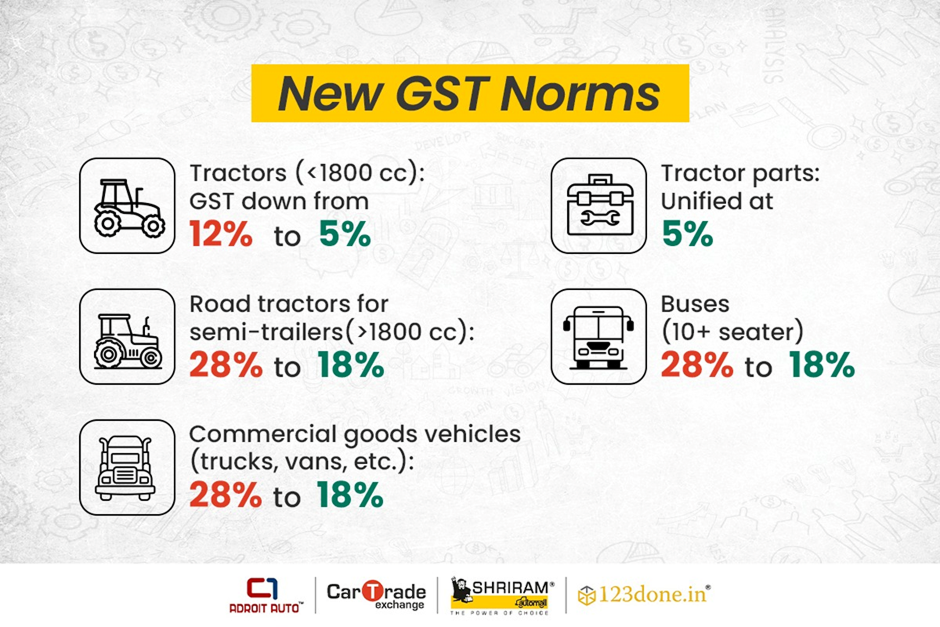
The 56th GST Council meeting marked a watershed moment for the Indian automobile industry. The sweeping rationalization of GST rates under GST 2.0, with significant reductions for small cars, buses, three-wheelers, goods carriers, tractors, and critical auto parts, has the potential to reshape the demand dynamics of both the new and used vehicle segments. While most discussions have focused on the immediate relief for new vehicle OEMs and consumers, the implications for the used vehicle ecosystem, particularly Commercial Vehicles (CVs) are far-reaching and deserve equal attention.
One of the most impactful announcements under GST 2.0 has been the rate rationalization for commercial vehicles, trucks, and buses. The GST rate has been reduced from 28% to 18% for goods vehicles (HS 8704), buses (HS 8702), and chassis with engines and bodies (HS 8706/8707). Along with this, third-party insurance for goods carriers has been reduced from 12% to 5%, further lowering operating costs. Together, these reforms deliver a significant reduction in the total cost of ownership (TCO) for fleet operators. For heavy trucks, the net savings can be in the range of ₹3–5 lakhs per unit, while for LCVs and buses, the savings are equally attractive at ₹50,000–2 lakhs. This represents a substantial boost for the new commercial vehicle market and is expected to accelerate fleet renewals and purchases.
As new commercial vehicles become cheaper with GST rationalization, the residual value and price benchmarks of used CVs will inevitably undergo correction. Dealers may need to recalibrate pricing models as the perceived gap between new and used vehicles shrinks. For instance, a transporter who previously saw a ₹6–7 lakh saving by buying a 3-year-old used truck may now find the benefit reduced to ₹3–4 lakhs due to new vehicle tax savings. This could trigger a re-pricing of used trucks and buses across markets, especially in organized auctions and dealer sales. In the short run, this might compress dealer margins, but in the long run, it will lead to greater transparency and realistic valuation benchmarks for the used CV ecosystem.
Unlike new vehicles, the press release did not announce any direct relief for used vehicles or margin-based GST valuation schemes. The existing 18% GST on dealer margins for used CVs remains unchanged. This creates a dual pressure point:
For Shriram Automall, which has been the pioneer in creating a trusted ecosystem for buying and selling used trucks, these GST reforms will bring both challenges and opportunities. On one hand, reduced new truck prices may soften demand and valuations in the used truck auctions. On the other, the reforms will expand the overall CV ownership base, leading to higher replacement cycles and more vehicles entering the resale market over time. To stay ahead, we at Shriram Automall must adopt a two-pronged strategy: recalibrate auction pricing models in line with new tax dynamics and strengthen value-added services such as parking, documentation, financing, logistics and rural outreach. By aligning with the new GST reality while continuing to offer trust and transparency, Shriram Automall can consolidate its leadership and ensure that auctions remain the preferred choice for both sellers and buyers of used trucks.
The GST 2.0 reforms have reset the playing field. By making new vehicles more affordable, they have indirectly challenged the used CV segment. This will inevitably lead to shifts in buying patterns and future volumes, particularly in heavy and light CVs. However, the fundamental demand for affordable mobility, replacement vehicles, and liquidity-driven sales will continue to support the used segment. The onus is now on industry pioneers—like Shriram Automall, to reimagine solutions that sustain customer trust and ensure the used automobile industry continues to thrive in the new GST era.

Shriram Automall: Reinventing Construction, Reshaping the Future

Impact of gst 2.0 reforms on the used vehicle segment: a commercial vehicle perspective

Gst 2.0 and the used vehicle revolution: why trucks will drive the next big shift

Mileage of a movement: how a phygital dream redefined indian transport
Accelerating Tomorrow: Decoding India’s Used Commercial Vehicle Market in FY 2025-26